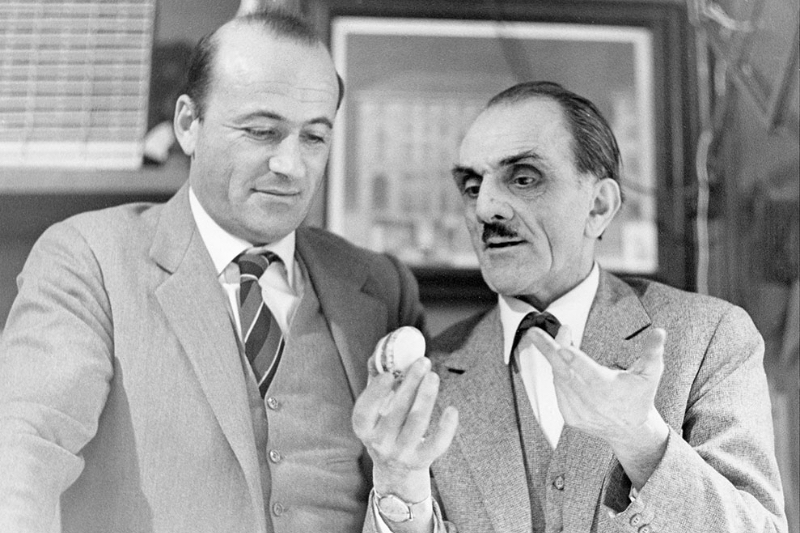



Italian design great Carlo Mollino returned with a new table: more than 50 years after his death.
Zanotta has secured an exclusive license for the production of a selection of his works after acquiring his artistic archive, with the Vertebra table making its debut.
The table exemplifies Mollino’s approach to furniture design, perceived not as mere decoration, but as an extension of the body in motion. Its sinuous, almost skeletal structure evokes anatomical forms and dynamic trajectories, reflecting the sensibility of a designer who was also a skier, racing driver, and aviation enthusiast.
Presented in the Zanotta flagship store within an installation inspired by Mollino’s interiors – where curtains fluidly define space – and by the organic forms of the human body combined with the dynamism of movement across snow, track, and sky, the table is showcased in a dedicated dining setting.
This was accompanied by a selection of Zanotta products – including the Fenis chair; Gilda armchair; Arabesco table; Milo mirror and Ardea seating – which highlights the enduring relevance of Mollino’s design language.
Mollino (1905-1973), professor of Architectural Composition at the Polytechnic University of Turin, is recognised as one of the most influential figures in 20th-century Italian aesthetics. His work spans architecture, photography, set design, and industrial design, embodying a unique fusion of creativity and innovation. In addition to the 30 design drawings intended for industrial production, Mollino’s professional archive, preserved by the Faculty of Architecture at the Polytechnic University of Turin, comprises nearly 17,000 graphic plates, technical drawings and sketches. It also includes approximately 15,000 photographs, more than 70 handwritten and typewritten documents, and an extensive collection of personal and professional correspondence.
He is renowned for his zoomorphic forms, anatomical curves that trace sinuous trajectories, creating intricate arabesque and a design language that merges abstraction with surrealism.
Mollino was a decidedly sporty driver, at least according to architect Pier Cario Jorio who swore at the time never again to accept a lift from Mollino after being driven from Turin to Cervinia. Mollino designed the Bisiluro car, which competed in Le Mans in 1955. The car- now preserved at the Science Museum in Milan- weighed just 450kg and could reach 220km/h with its 750cc Giannini engine.
Photo: Carlo Mollino (right) Carlo Mollino and Carlo Graffi presenting the project of the Regio Opera House, Turin in 1966/Museo Casa Mollino. The Museo Casa Mollino can be visited by appointment by writing to [email protected]. In a two hour visit in English, Italian or French, the visitor is led through the story of Mollino’s life and the interpretation of the apartment. A 30-minute video by the artist Yuri Ancarani titled Seance can be watched after the visit. The entrance fee is €50.