

One of the UK’s leading recycled material design studios that supplies the furniture and interiors sector is set for expansion after securing almost £1m in funding.
Smile Plastics has secured £980,000 in equity funding to grow the business and is planning to relocate its manufacturing base to a much larger facility in Swansea, ratchet up production capacity by a factor of three, and double the size of its team.
Smile was first established in the early 1990s – a time when recycling plastic was a niche interest and climate crisis a much lower-tier global concern than today. Launched by Colin Williamson and Jane Atfield, the business was a small operation, focused on making 100% recycled plastic panels for the design industry.
For two decades, Smile led the way in the drive to reclaim and recycle plastic waste while demonstrating the design potential of recycled plastic – perhaps most notably when Jane Atfield’s RCP2 Chair, made entirely of recycled plastic bottles, was added to the V&A’s permanent collection.
The business wound down when Colin Williamson retired in 2010, and would have been consigned to history were it not for circular-material specialist Adam Fairweather, who had met Williamson while at university and collaborated with him on a coffee-waste bioplastics project, and psychology student-turned-jewellery designer Rosalie McMillan.
In 2014, a time when the necessity of environmental preservation and the threat of climate change were becoming increasingly urgent, McMillan and Fairweather saw that Smile had the potential to fulfil a growing need for sustainable designable material solutions for the creative sector, and approached Williamson with a proposal to revive the dormant business. He gave them his blessing, and they set about reimagining the business for the modern age.
Having developed new processing techniques and low-energy manufacturing technology that allowed them to produce recycled-plastic panels via a continuous batch process, Smile was relaunched in 2015. In the past seven years, Smile has expanded, developing a committed international customer base, alongside ever more advanced production methods and technology, and an always-growing range of products, in all sizes – as well as a popular custom manufacture service.
The company’s distinctive, terrazzo-like surfaces have become regular sights at major global design events, thanks to an ongoing programme of collaborations with designers and creative studios, and in high-profile commercial, retail and hospitality spaces worldwide.
Smile taps into the waste streams of more than 60 local businesses, which supply the factory with materials ranging from drinks cups and cosmetics bottles, to yoghurt pots and used plastic packaging. Having sorted these materials by colour, Smile selects these ingredients depending on the colour and pattern desired.
Shredded, heated and pressed into sheets, these combinations of different plastics create variety of surface patterns – from the natural stone mimics like Grey Mist and Alba, to vibrant, maximalist styles such as Kaleido, in which you can still glimpse traces of the barcodes from the products that formed it. Any waste plastics or substandard materials generated during manufacture are shredded again and returned to the beginning of the process, so production is as close to zero-waste as possible.
Depending on the material mix, they can be thermoformed into 3D structures, CNC-milled, cut, edged or jointed to suit their intended purpose, whether it’s a table top, a washroom counter, a wall panel, a piece of signage, a storage box or furniture.
‘Plastics are considered a modern, even unnatural, material, but they have a primaeval history, rooted in the living world. In some ways, plastics can be considered as old as stone – there’s an embodied value in that. Our mission is to encourage people to recognise that value and therefore waste less. We do this by re-imagining end-of-life materials into beautiful new products that tell a story and that people can connect with,’ says Fairweather.
The investment recognises Smile’s closed-loop, full-circle ecosystem – currently delivering over 500 tonnes of CO2 savings each year compared to conventional methods of making plastic. This funding is being used to purchase a new larger factory space in Swansea, obtain new machinery to establish parallel production lines, and expand the staff. This has meant that Smile Plastics is now producing 100% recycled, recyclable plastic 24 hours a day, seven days a week, and is now able to deliver outputs of a size and scale never possible before. In the next financial year, Smile is on track to divert 1,500 tonnes of plastic waste from landfill into valuable products.
McMillan and Fairweather says the Smile model of turning local waste streams into local products via local micro-factories to support local economies is a template for a new approach to manufacturing as an entirely circular system of sustainable, hyperlocal making with the potential to be deployed anywhere in the world.
‘We are looking to start building a distributed network of micro-factories, taking local waste streams and transforming them into panels and products for local markets around the world. The past seven years has proven that the ecosystem we have developed is viable; now we are excited to see how far the Smile Plastics model can go. We are planning a potential site in Europe for 2023, paving the way for a Continental production line. We can envisage a world in which every major city has its own micro-factory,’ says McMillan.
Smile’s Classics range is made from post-consumer and post-industrial recycled plastics including rHIPS, rPET and HDPE and clients include Another Country, Mercedes-Benz, Ganni, Christian Dior and Selfridges.
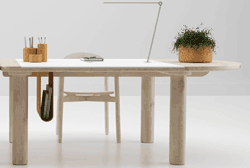
Image: Another Country’s Work Two.